
In April 2026, Proof News reporter Annie Gilbertson published an investigation into a case that should be on every benefits leader’s desk. Jennifer Kamrass, a nurse practitioner at AdventHealth, was terminated in 2021 while nearly nine months pregnant. She used Talkspace — a digital therapy platform her employer offered as a benefit — to work through the anxiety of losing her job and supporting her family weeks before giving birth. When she later filed a pregnancy discrimination claim, AdventHealth’s lawyers subpoenaed her complete Talkspace messaging history, including her sessions with the therapist who had agreed to testify on her behalf. The transcripts were produced in court. A federal judge ruled in AdventHealth’s favor, accepting the employer’s argument that the termination stemmed from a facility closure.
The story has been told most often as a privacy violation, or as one woman losing against a large institution. Both framings are true as far as they go. But for anyone responsible for designing or procuring employee benefits, neither is the most useful reading. The most useful reading is this: a benefit the employer paid for became evidence in the employer’s defense — lawfully, through ordinary discovery — and the exact same mechanism is available to the next employee’s lawyer when the employer is the defendant.
This is a governance analysis, not legal advice, and it is built entirely on public reporting. Its purpose is to show what a structured governance review would have surfaced before the benefit was ever offered.
Nothing Went Wrong. That Is the Problem.
It is tempting to read this as a breach or a failure of controls. It was neither. The disclosure was lawful. AdventHealth’s lawyers obtained a court order. Talkspace produced the records. Under HIPAA’s court-order provision, nothing in that chain was procedurally improper. The system worked exactly as designed.
The structural fact underneath it is a classification decision most employees would never think to ask about. HIPAA gives heightened protection to “psychotherapy notes” — the sparse, separate observations a clinician records — requiring explicit consent before disclosure. But chat-based therapy does not produce psychotherapy notes. The transcript is the treatment, integrated into the medical record. That makes the entire word-for-word exchange an ordinary medical record, and ordinary medical records are discoverable. The distinction was made at the level of product architecture, not by a clinician, and the people generating the records had no reason to know it had been made.
This is what makes it a governance problem rather than a security problem. Nothing failed. The exposure was built in — and it was knowable at onboarding.
The Chain Runs in Reverse
This is the point that compliance and HR commentators have begun to raise since the Proof News investigation, and it is the one employers most need to internalize. AdventHealth used the discovery process to reach an employee’s sponsored therapy records in its own defense. The same process is available to a plaintiff’s lawyer when the roles are reversed.
An employer-sponsored mental health benefit is a record-creating system. Employees use it — in volume — precisely during periods of workplace stress: a difficult manager, a reorganization, a harassment situation, a disability accommodation gone wrong. Those are exactly the conditions that later become employment litigation. If an employee sues, the records they generated in a sponsored benefit can be subpoenaed the same way, with the same result. If those records show that the employer knew about a workplace condition, a reported pattern, or a hazard it documented but did not address, the benefit offered as support becomes an exhibit for the other side.
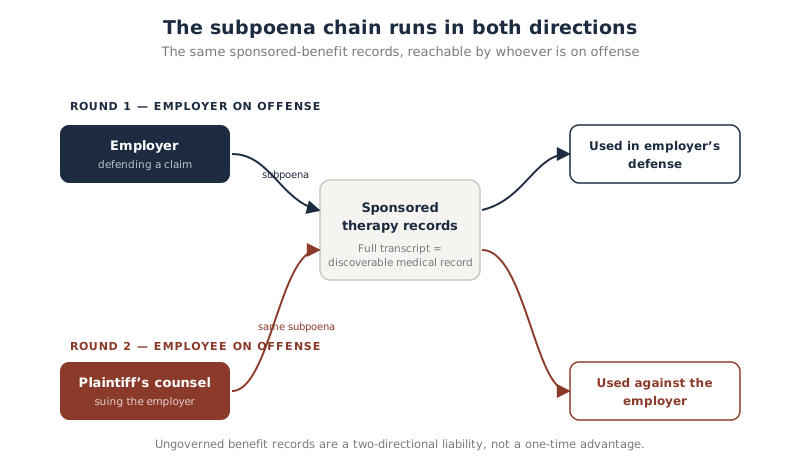
The insight that the chain runs both ways is not original to this analysis — it is now circulating in benefits-procurement and ERISA-counsel commentary. What Small Data Ethics adds is not the observation. It is the method for acting on it before the contract is signed.
What ETHICMAP Would Have Surfaced at Onboarding
ETHICMAP is an implementation cycle for Small Data Ethics, built for repeatable program operations. Run against a vendor like this at onboarding, four dimensions carry most of the weight.
Environment — constraints, norms, and power dynamics. A workforce using an employer-sponsored therapy benefit is not a neutral consumer market. Employees navigate an institution with power over their livelihoods, and they used the benefit believing it carried clinical confidentiality. That asymmetry is an active design constraint. Environment requires naming it before signing — including the uncomfortable question of what the employer’s own legal team could do with the records later.
Timing — cutoffs, lags, retroactivity, and notice. Kamrass created her records in 2021 and saw them surface in litigation two years later. There was no notice that records made today could be discoverable later, no retention cutoff, no disclosure of the gap between creation and exposure. The retroactivity failure is the heart of it: records made under an assumption of confidence became evidence under rules nobody disclosed at the time.
Harmony — who benefits, who is burdened, who is exposed. Who benefited: the employer’s litigation position. Who was burdened: the employee. Who was exposed: every employee who used the benefit believing it was private. Because the chain runs in reverse, the same instrument burdens employees in litigation while, in the next case, exposing the employer. Harmony forces that distribution into view at onboarding, when it can still be changed.
Incentive — feasibility without coercion. Talkspace’s incentive was data accumulation — it has described holding one of the largest mental health data banks in the world and reserves the right to use de-identified session data to develop AI products. The employer’s incentive was a competitive benefits package. The employee’s incentive was confidential support. When the parties’ incentives diverge this sharply, participation that looks voluntary may not be: the terms do not support the confidence the benefit appears to offer.
The remaining four dimensions complete the cycle. Calibration names the gap between what employees believed the benefit was and what it legally was — a gap nobody closed. Measurement notes that the vendor measured its data holdings precisely while no one measured what the benefit was doing to employee risk exposure. Application asks how a benefit gets renewed year after year without anyone re-examining the classification problem. And Publish is the final failure: no documented vendor governance decision, no classification disclosure to employees, no policy on whether legal could reach sponsored records — and when Universal Health Services agreed to acquire Talkspace for $835 million in 2026, the dataset traveled with it, under consent terms employees never revisited.
How Governance Protects the Employer, Not Only the Employee
The framing that this is purely an employee-protection issue is the one that keeps it off the procurement agenda. The sharper argument is that the same governance protecting the employee protects the employer. Three artifacts, produced at onboarding, reduce institutional exposure directly.
A vendor data classification disclosure at enrollment
Telling employees plainly that platform records are treatment records, not protected psychotherapy notes, and what that means for discoverability. This moves informed consent from assumed to documented — the posture an employer wants on record if consent is ever questioned.
A firewall policy
A written organizational commitment not to seek discovery of sponsored mental health benefit records in litigation against employees. Giving up that one-time tactical advantage is precisely what neutralizes the reverse-direction risk. A documented firewall is far cheaper than the case where sponsored records become a plaintiff’s exhibit.
A vendor data-use audit before signing
Asking directly whether session records train other products and whether that use is disclosed at enrollment. A platform reserving the right to use session data for AI development is a clause to surface before the contract, not after the subpoena — and after an $835 million acquisition, the question of who holds the data and under what terms is no longer hypothetical.
The scenario where the employer loses is not the Kamrass case. It is the next one — where a plaintiff’s lawyer pulls sponsored benefit records the employer created without governance, and they reveal something the employer knew.
The Takeaway for Benefit Design
Every sponsored benefit delivered through a third-party platform is a record-creating system. Most benefits leaders evaluate these vendors on cost, engagement, and member experience. Few evaluate them on what records the benefit creates, how those records are classified, and who can reach them under what conditions.
That evaluation is not exotic. It is a short set of questions, asked once, at onboarding, and revisited at renewal. The cost of asking them is a few hours of governance work. The cost of not asking them is set by someone else, in a venue the employer does not control, at a time of someone else’s choosing. Jennifer Kamrass learned that the benefit her employer paid for could be turned against her. The lesson for employers is that it can just as easily be turned against them.
Nothing went wrong — until it did. That is the nature of governance risk: invisible right up to the moment it is the only thing anyone can see.