
By Laini Byfield
Small Data Ethics is not Small Data Privacy
Privacy is a core concern in small data. Small Data Ethics is the wider frame — it includes privacy and also fairness, power, incentive, explainability, and repair.
PrivacyFairnessAccountabilityRepair
The core distinction
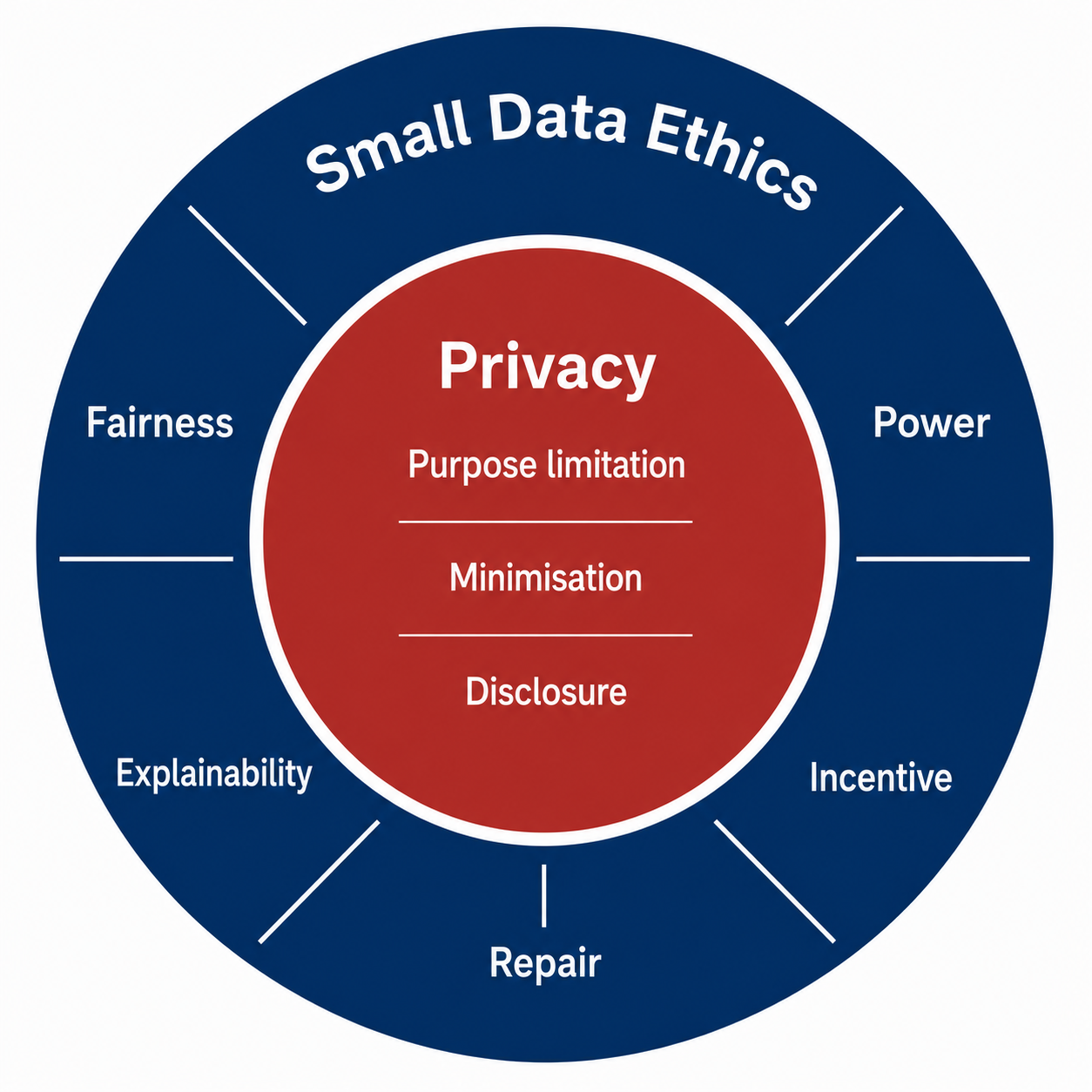
The distinction in one sentence
Small Data Ethics is a lens for how human-scale data should be collected and used. A Small Data Privacy Committee is one governance mechanism focused on privacy risk and appropriate information flows.
Privacy is one element of Small Data Ethics — not a substitute for it
Compliance with privacy law is the floor. Small Data Ethics asks what belongs above it.
Side by side
Comparison
Small Data Ethics — the lens
- Privacy plus fairness, incentive, and power
- Assumes relational exposure — not anonymity
- Treats errors as moral events — not technical bugs
- Requires contestability, traceability, and repair
Privacy Committee — one mechanism
- Reviews privacy risk, disclosure, and access
- Ensures purpose limitation and minimisation
- Defines reporting suppression for small-n
- Approves retention rules and sharing boundaries
How they connect
How they work together
A privacy committee can be one part of Small Data Ethics governance. ETHICMAP can serve as the committee’s standing agenda and documentation structure:
- Environment and Timing surface where privacy risk spikes
- Harmony tests who is disproportionately exposed in small-n reporting
- Measurement requires error rates and uncertainty, not just point outcomes
- Publish becomes the feedback loop — decisions and changes documented for the next cycle